on-demand computing (ODC)
What is on-demand computing (ODC)?
On-demand computing (ODC) is a delivery model in which computing resources are made available to the user as needed. The resources might be maintained within the user's enterprise or made available by a cloud service provider.
The on-demand business computing model was developed to overcome the challenge of enterprises meeting fluctuating demands efficiently. Because an enterprise's demand for computing resources can be unpredictable at times, maintaining sufficient resources to meet peak requirements can be costly. And cutting costs by only maintaining minimal resources means there are likely insufficient resources to meet peak loads. The on-demand model provides an enterprise with the ability to scale computing resources up or down whenever needed, with the click of a button.
As the term suggests, on-demand computing simply means making computing resources available to users on demand. The term cloud computing is often used as a synonym for on-demand computing when the services are provided by a third party -- such as a cloud hosting organization (also known as a cloud service provider or CSP). For this reason, the definition of on-demand computing can be extended to the cloud realm as "a delivery model in which cloud computing resources such as compute, storage, networking, and software are made available to the user as per their need or demand."
On-demand computing normally provides computing resources such as storage capacity, or hardware and software applications. The service itself is provided with methods including virtualization, computer clusters and distributed computing.
How does cloud computing on-demand work?
In the context of cloud computing, the on-demand computing model is characterized by three attributes: scalability, pay-per-use and self-service. Whether the resource is an application program that helps team members collaborate or provides additional storage, the computing resources are elastic, metered and easy to obtain.
When an organization pairs with a third party, such as a CSP, to provide on-demand computing, it either subscribes to the service or uses a pay-per-use model. The third party then provides computing resources whenever needed, including when the organization is working on temporary projects, has expected or unexpected workloads, or has long-term computing requirements. For example, a retail organization could use on-demand computing to scale up its online services, providing additional computing resources during a high-volume time, like Black Friday.
How does cloud computing provide on-demand functionality?
On-demand computing often involves cloud computing methods, such as infrastructure as a service (IaaS), software as a service (SaaS), desktop as a service (DaaS), platform as a service (PaaS), managed hosting services, as well as cloud storage and backup services.
- IaaS provides virtualized computing resources over the internet.
- SaaS is a software distribution model where a cloud provider hosts applications and makes them available to users over the internet.
- DaaS is a form of cloud computing where a third party hosts the back end of a virtual desktop infrastructure.
- PaaS is a model in which a third-party provider hosts customer applications on their infrastructure. Hardware and software tools are delivered to users over the internet.
- Managed hosting services are an IT provisioning and cloud server hosting model where a service provider leases dedicated servers and associated hardware to a single customer and manages those systems on the customer's behalf.
- Cloud storage is a service model where data is transmitted and stored securely on remote storage systems, where it is maintained, managed, backed up and made available to users over a network.
- Cloud backup is a strategy for sending a copy of a file or database to a secondary location for preservation in case of equipment failure.
These cloud-based services are typically made on-demand and in real time for users. Computing resources are delivered using a shared pool of servers, storage devices, networks and applications.
Cloud hosting providers may provide an enterprise-level control panel where they can quickly view and scale up or down their cloud services. An organization could use this to access the storage space, speed, software applications, servers or networks they need at any given time.
What are the advantages of on-demand computing?
The on-demand computing model was developed to overcome the challenge of enterprises meeting fluctuating demands efficiently. Because an enterprise's demand for computing resources can be unpredictable at times, maintaining sufficient resources to meet peak requirements can be costly. And, cutting costs by only maintaining minimal resources means there likely are insufficient resources to meet peak loads. The on-demand model provides an enterprise with the ability to scale computing resources up or down whenever needed, with the click of a button.
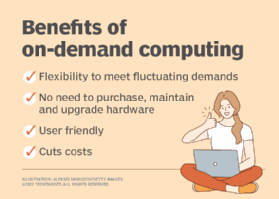
In addition, on-demand computing offers the following benefits:
- Flexibility to meet fluctuating demands. Users can quickly increase or decrease their computing resources as needed -- either short-term or long-term.
- Eliminates the need to purchase, maintain and upgrade hardware. The CSP managing the on-demand services handles resources such as servers and hardware, system updates and maintenance so the user organization is saved from making large capital expenditures on these elements. Organizations also don't have to worry about updating or maintaining those resources because the CSP takes care of these aspects as well.
- User-friendly. Many cloud-based, on-demand computing services in the cloud are user-friendly and easy to access since they are available via a self-service model. This enables most users to easily acquire additional computing resources with minimal or no help from their IT department. This can help speed up access to these business or mission-critical resources, which then improves business agility.
- Access to the latest technologies. The largest CSPs invest in the latest technologies such as machine learning, computer vision, and the internet of things (IoT) that organizations can access for their requirements without having to make large investments. For smaller companies, access to these technologies helps level the playing field, allowing them to innovate and compete on equal grounds with larger competitors.
The possible drawbacks of on-demand computing
Notwithstanding the benefits of on-demand computing, organizations must also be aware of some of its possible pitfalls. For example, they must be concerned about the unauthorized use of added resources via on-demand computing. This problem is known as shadow IT and can pose security risks for the organization. This is because the added resources (by employees without the permission, approval, or knowledge of the IT team) might contain security vulnerabilities that can be exploited by threat actors to compromise the organization and its resources (such as its accounts or data).
For this reason, IT departments should perform periodic cloud audits to identify unauthorized use of on-demand applications and other rogue IT scenarios, and then take appropriate action to remove those resources. It's also important to train users about the risks of shadow IT with on-demand computing.
The future of on-demand computing
Large vendors such as Amazon Web Services, HPE, IBM and Microsoft offer on-demand computing products. Microsoft, for example, provides Azure SaaS and AWS offers pay-as-you-go pricing with its IaaS offerings.
As more of these services become available, there is a greater chance that enterprises will look to on-demand computing as a way to facilitate the challenges of fluctuating computing resource needs as their organizations grow and evolve to keep up with changes in their markets, industries, and customer needs.
Learn more about the characteristics of cloud computing, including on-demand computing and self-service provisioning. Read about pay-as-you-go storage consumption and its challenges.