capacity on demand (COD)

What is capacity on demand (COD)?
Capacity on demand (COD) is a purchasing option that allows companies to receive equipment with more computer processing, storage or other capacity than the company needs at the time of purchase, and have that extra capacity remain unused and unpaid for until the company actually requires it.
Vendors promote COD as a cost-effective and time-saving alternative to more traditional methods of upgrading or licensing their products. For example, a vendor might provide a company with a fully configured server that includes 48 processor cores but charge the company only for the cores they initially require. The company can then increase the number of cores when needed, paying the additional costs.
With COD, vendors offer their customers additional capacity on a pay-per-use basis, hoping the customers will take advantage of the capacity when needed, rather than purchasing hardware from another vendor. If customers decide to use the additional capacity, they simply contact the vendor to have that capacity activated. The vendor will then bill them accordingly.
The COD model can apply to processor cores, memory modules, storage capacity, tape library cartridge slots or other types of IT resources. For customers, COD is a convenient way to avoid forklift migrations to new hardware configurations.
One of the challenges with COD is that customers are locking themselves into a single vendor, which can reduce flexibility and sometimes result in higher costs. Critics have also pointed out that COD can lead to poor capacity planning, which can also translate to higher costs.
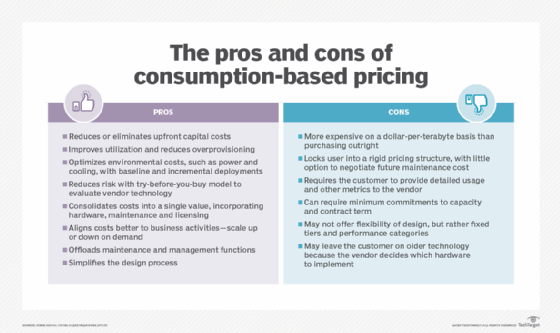
Capacity on demand in action
The concept of COD is broad and can be applied in different ways, depending on the vendor and type of products being sold. IBM, for example, offers COD for its Power Systems platforms, enabling customers to temporarily activate and deactivate processor cores or memory units based on current business requirements.
To request capacity, the customer contacts an IBM seller or business partner to purchase activations. The customer then receives an electronic enablement code from IBM, usually within 24 to 48 hours. IBM bills the customer monthly, but only for the services used.
IBM has been at the forefront of providing services under the COD label, but IBM is not alone. Oracle also offers COD for its Exadata database server systems, allowing the number of active cores to be increased when capacity is needed. However, COD does not apply to the storage server cores and it can't be used to decrease the number of active cores after the initial installation.
More importantly, the COD policy does not affect the costs of the actual hardware, only the software licensing. It reduces the initial per-core licensing fees by limiting the number of cores that the customer can use, but the customer saves nothing in hardware costs.
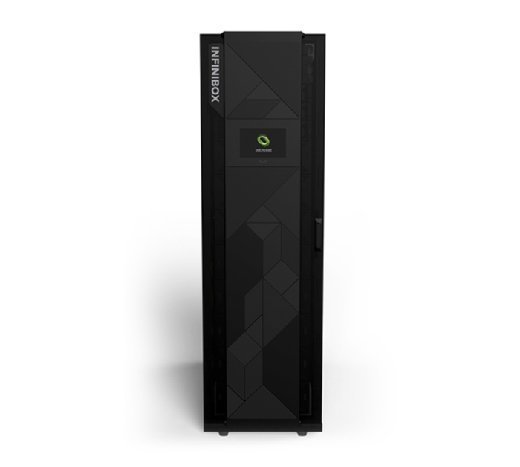
Infinidat also offers COD pricing on its InfiniBox enterprise storage systems. When a customer purchases an InfiniBox system, it is preconfigured at full capacity. However, the customer pays only for the initial capacity that will be used, not the full amount that is installed. The customer can then purchase additional storage in 10 TB increments.
Storage usage is evaluated daily based on the highest level of allocated capacity, which is the total capacity presented to the servers and applications. Customers are charged only once for the additional capacity, rather than having to pay ongoing subscription fees.
The COD model also can be applied to other types of hardware, such as Quantum's Scalar i3 tape storage systems. Scalar i3 systems come with COD software that makes it easy to add storage capacity.
For example, a customer might purchase a Scalar i3 storage system configured with hundreds of physical cartridge slots but may need only 20 or 25 slots initially. With COD, the customer pays only for the initial slots (the COD-licensed slots) but can license additional slots at any time as needed.
A number of vendors have moved to a consumption-based, pay-as-you-go delivery model that incorporates COD principles. One of the most well-known efforts is HPE GreenLake, an as-a-service program for providing customers with complete and preconfigured systems. Although customers run these systems on premises, they get some of the same flexibility offered by cloud services.
As with COD products, GreenLake systems come with additional capacity that customers can tap into as required, paying for the capacity only when they need it.
Learn more about pay-as-you-go storage consumption and its challenges and how it works. Also, explore storage-as-a-service and consumption models from major enterprise storage vendors and how consumption models help simplify storage buying options.