
kantver - Fotolia
How do I convert CPU hours to MIPS for mainframe capacity planning?
For better mainframe capacity planning, how do I convert CPU hours to MIPS? And is there a way to calculate the relationship between MIPS and MSUs?

Although they aren't exact numbers, mainframe capacity planners find CPU hours, MIPS and MSUs good indicators for plotting future growth. Reducing MIPS is also a huge priority for mainframe users who want to contain software costs.
Mainframe shops can use these handy shortcuts to learn about CPU, MIPS, mainframe application capacity planning and converting CPU hours to MIPS.
On the mainframe, MIPS is generally a measure of computing capacity. IBM publishes the relative MIPS for each processor family through its Large System Performance Reference, which is based on statistical analysis of what IBM considers representative workloads. However, a mainframe system's actual performance depends on its IT workload profile and the number of installed engines. This is especially true for IBM's z13 hardware offering, which sacrifices raw clock speed for bigger caches and more sophisticated instruction pipeline processing.
Million service units (MSU) is the measure of machine capacity generally used for calculating software licensing costs. MSU ratings are closely related to MIPS, although IBM sometimes manipulates MSUs to encourage mainframe users to upgrade to new hardware. To account for the multiprogramming effect, IBM assigns MSU ratings for different processor models on a sliding scale depending on the number of active processing units -- also referred to as CPs by IBM.
To convert CPU seconds (accumulated consumption) to MIPS (average consumption speed), the capacity planner divides the equivalent uniprocessor MIPS (EMU) by the elapsed seconds, then multiplies the result by the CPU seconds. That result is the MIPS. EUM is defined in the REstructured eXtended eXecutor language's REXX exec.
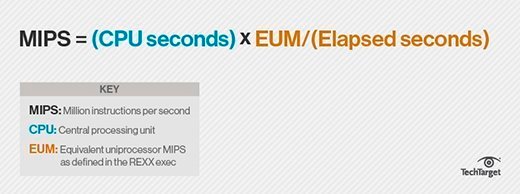
CPU seconds to MIPS conversion example
A mainframe job has used 100 CPU seconds during one minute -- it is a multitask job. The system is an IBM 2064 Model 1C5 (1085 MIPS, EUM = 217 MIPS). The average consumption speed of this job is 100 x 217/60 = 362 MIPS.
Cutting CPU costs on the mainframe and improving the system's operational efficiency, however, are not always the same thing, which leaves room for debate about what metrics, including CPU hours and others, to share with the business.
Editor's note: This was first published in February 2012 and updated in February 2016.